
Welcome back to Lambergg’s Insiders.
Millions of Americans rest easy believing that their family home is completely untouchable. They know that if they ever need a nursing home, Medicaid generally treats their primary residence as an "exempt asset," meaning they won't be forced to sell it to qualify for care.
This creates a massive, dangerous illusion of security.
What the government doesn't openly advertise is what happens after you pass away. Today, we are going to expose a mandatory federal process that is quietly ripping family homes away from the middle class, and how you can legally wall off your legacy before the government sends the bill.
Let's dive in.
LEGACY TIP OF THE WEEK
Spousal Impoverishment
When one spouse enters a nursing home and the other stays in the primary home, Medicaid allows the healthy spouse to keep a certain amount of combined resources so they can continue living independently. In 2026, this "spousal impoverishment" provision protects assets worth up to $162,660. This rule only protects the healthy spouse while they are alive. While Medicaid cannot attempt estate recovery if there is a surviving spouse, some states will aggressively attempt to collect the debt after the death of the surviving spouse.
You cannot rely on temporary spousal exemptions to permanently protect your life savings. Both spouses must utilize a structural, irrevocable asset protection framework well before the need for long-term care arises, completely separating the home from the government's reach.

How the Government Takes the House
Federal law requires every state to operate a Medicaid Estate Recovery Program (MERP). Through MERP, the state's Medicaid agency seeks mandatory reimbursement for the long-term care costs it has paid on behalf of a beneficiary.
If you are 55 or older and receive Medicaid-covered long-term services, the government is meticulously tracking every single dollar they spend on your care.
Here is how the mechanical trap springs shut on your children:
-
Estate recovery occurs after the Medicaid recipient's death. It is typically pursued against assets held in the recipient's name at the time of death, which is most commonly the individual's home. To recoup the money spent on long-term care, Medicaid Estate Recovery often targets the one asset families most want to preserve their home.
-
Following your death, the Medicaid agency generally sends a letter to the executor of your estate. This letter bluntly informs your family that the state intends to file a claim for repayment of all long-term care costs.
-
You might think you can outsmart them by avoiding probate court. But states have the option to use an "expanded" definition of estate recovery, allowing them to seize assets that do not go through probate. Depending on your state's rules, jointly owned property, living trusts, and other non-probate assets can also be subject to estate recovery.

A standard "Revocable Living Trust" will not save you, because the expanded MERP rules allow the state to pierce it effortlessly.
The ultra-wealthy use an Irrevocable Asset Protection Trust to permanently solve this problem. Because an Irrevocable Trust legally removes the home from your personal ownership footprint long before you ever need care, the house is technically not part of your estate when you pass away. When the state sends the MERP demand letter, your estate is legally empty, and your family home passes cleanly to your children.
CASE STUDY
The Suburban Farm That Was Reclaimed by the State
Margaret (76) owned a beautiful, paid-off home sitting on 10 acres of land. She suffered a severe stroke and required 24/7 skilled nursing care. Because the home was her primary residence, it was exempt from the asset limit, and she successfully qualified for Medicaid.
Margaret spent four years in the nursing home before passing away peacefully. Her total care bill over that time exceeded $450,000. Her children immediately moved to inherit the home, assuming it was safe because Margaret had carefully written a Will leaving it to them.

(Anonymized from elder law and state recovery records)
Two months after Margaret's death, the state's Medicaid Estate Recovery Program sent a formal demand letter to her son, the executor. They placed a massive lien on the property.
Because Margaret's home was held in her personal name at the time of her death, the state had the absolute legal right to force the sale of the home to recoup the $450,000 they had spent on her care. Margaret's children were forced to sell the family estate to a commercial developer just to satisfy the government debt. The children inherited absolutely nothing.
The Exact Video Training Our Private Clients Use
If you want to ensure that your home, your business, and your cash stay exactly where they belong regardless of what happens with the global economy, you have to take the wheel.
The system wasn't built to protect you. It was built to move your money somewhere else.
We took our complete Bulletproof Trust private client training, the exact step-by-step program we charge up to $20,000 to build for high-net-worth families and recorded the entire thing on video.
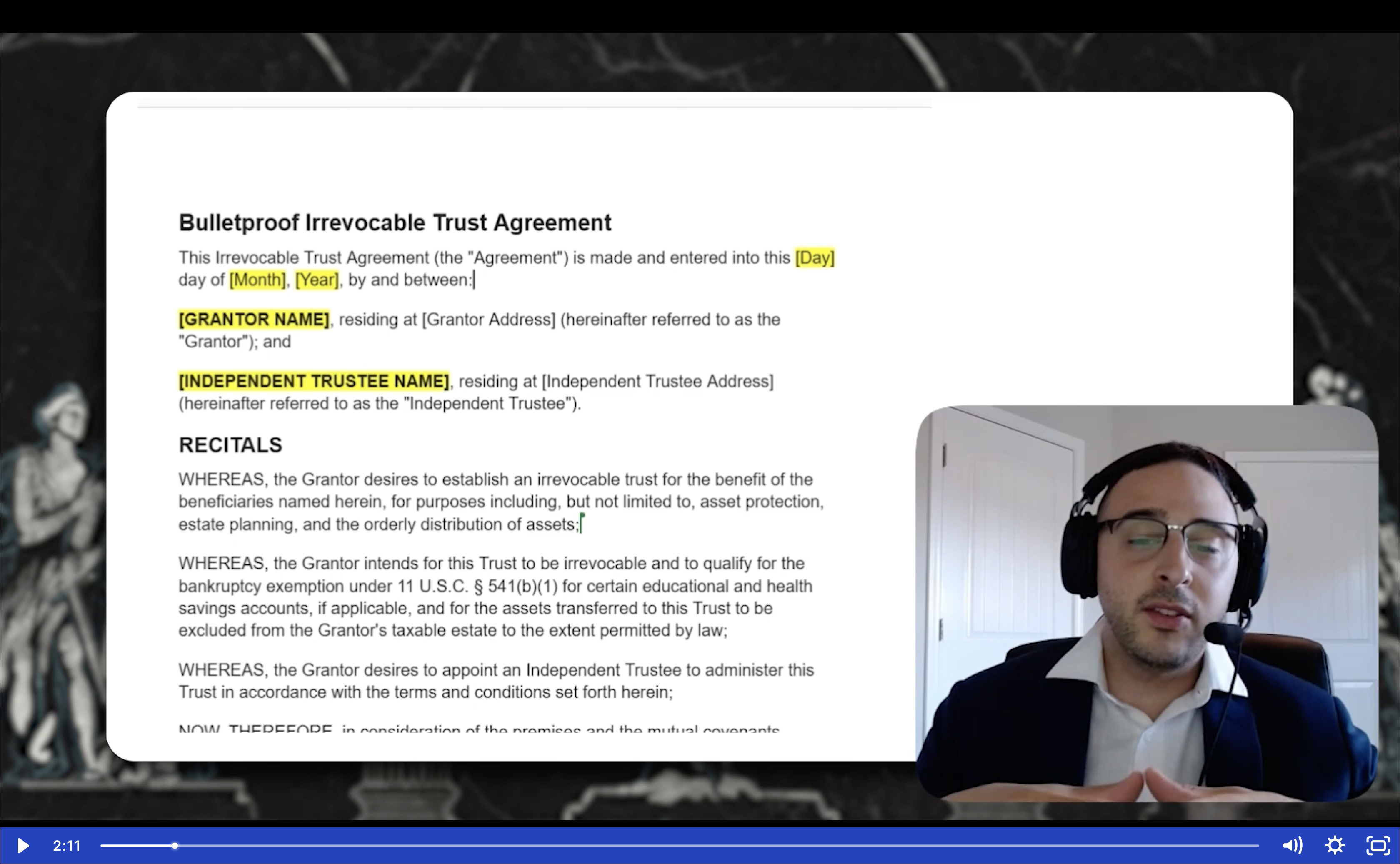
Inside the Bulletproof Trust Secrets video training, our lead trust attorney opens the legal documents and walks you through them page by page. Line by line. You will learn exactly how to structure every clause and fund every asset to shield your legacy from lawsuits, probate, divorce, and the IRS.
You hit play. You pause. You follow along. You build your own fortress.
You will know more about trusts than 95% of general-practice attorneys. You will be in control. Not your lawyer. Not the government. You.
→ Click Here to Access the Video Training ←
Legacy Defense Audit
Do not volunteer your family's biggest asset to the government. Take 5 minutes to audit your exposure today:
-
[ ] Pull the deed to your primary home. Is it in your personal name, or a basic Revocable Trust? If yes, it is a sitting target for the Medicaid Estate Recovery Program.
-
[ ] Medicaid employs a strict 5-year lookback period. If you wait until you get sick to transfer your home into a protective Irrevocable Trust, you will face massive penalty periods. You must build the shield while you are healthy.
-
[ ] Remember that while federal law dictates the minimums, each state enforces its own expanded MERP rules. Never assume a basic internet loophole will protect your family in your specific jurisdiction.
FROM THE INBOX
Q: "If my disabled child lives with me in my primary home, can Medicaid still take the house when I die?"
A: No. Federal law provides incredibly strong protections in this specific scenario. A state cannot place a lien on a Medicaid recipient's home or pursue estate recovery if the recipient is survived by a child of any age who is blind or has a disability. However, to ensure this exemption is honored without a grueling court battle, the home should still be properly structured and documented within a special needs planning framework.
HOW DID YOU LIKE THIS WEEK'S NEWSLETTER?
Your feedback helps us make this briefing even better.
If you found this intelligence valuable, please forward it to a friend or family member who needs to protect their legacy. We grow through your word-of-mouth.
Questions? Reply to this email or contact us at legalteam@lambergg.com
DISCLAIMER: This newsletter is for educational purposes only. Lambergg provides asset protection education, not legal advice. The information presented reflects general principles and may not apply to your specific situation. Tax laws, estate planning rules, and asset protection strategies vary by state and change frequently. Always consult with a qualified attorney and tax professional for advice tailored to your individual circumstances. Nothing in this briefing should be construed as creating an attorney-client relationship.
YOUR TURN
Did you realize that Medicaid legally demands repayment for your care after you pass away?
Are you relying on a standard Will to protect your home from the government? Reply directly to this email and let me know. I read every single response personally.
Until Friday, protect what matters.
The Lambergg Team