
Welcome back to Lambergg’s Insiders.
If you are like most responsible wealth-builders, you probably pay thousands of dollars every year for insurance. You have premium homeowner’s insurance, auto liability insurance, and maybe even a $1 million or $2 million "umbrella" policy.
You pay these bills month after month because you believe they form an impenetrable shield around your family. You think: "If anything happens, the insurance company will just handle it."
This is one of the most expensive misunderstandings in modern asset protection.
Today, we are going to expose how the litigation industry actually works behind closed doors, and why relying purely on an insurance policy can transform your family into a prime target for a devastating lawsuit.
Let's dive in.
LEGACY TIP OF THE WEEK
Asset Verification
When you apply for high-limit liability or umbrella insurance, companies frequently ask you to fill out an exhaustive asset questionnaire.
You diligently list your primary home, your rental properties, your brokerage accounts, and your corporate entities on their forms. If you ever get sued, these applications can be unmasked during the legal discovery process. You have essentially created a neatly typed map displaying exactly where all your personal wealth is located for an opposing attorney to see.
Never hold your crown-jewel assets in your personal name to begin with. If your real estate and investments are owned by a private, asset-protected trust, your personal questionnaire remains entirely clean, leaving nothing for predators to map out.

How Your Shield Becomes a Target
To understand why insurance alone is a dangerous defense, you have to look at how modern contingency-fee injury lawyers choose their targets.
When an accident occurs, whether it is a slip-and-fall on a property or a minor traffic collision, an aggressive plaintiff's attorney doesn’t immediately sue out of anger. They run a cold, calculated asset search before they ever file a complaint in court.
They use specialized databases to look up your name, your home deed, and your public asset footprint.
Here is the exact mathematical reality of how they evaluate you based on your planning:
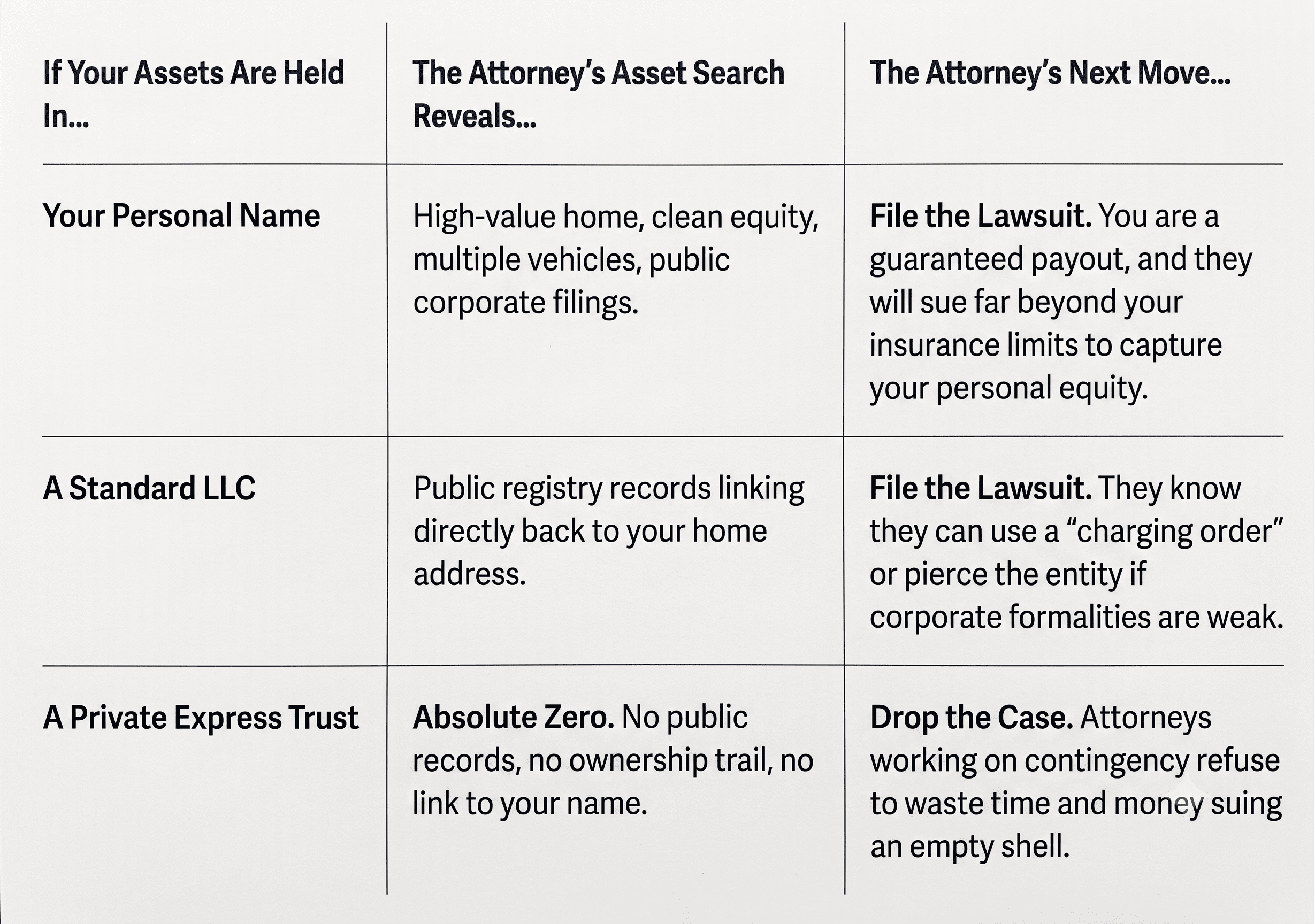
When you carry a massive umbrella insurance policy while keeping your assets in your personal name, you create a dangerous paradox. The insurance policy ensures there is a pool of cash available, which motivates the lawyer to take the case. But if the jury award or settlement demands exceed your policy limit, which happens frequently in severe claims, your personal home, bank accounts, and investments are completely exposed to satisfy the remaining balance.
Insurance companies are in the business of denying claims, not saving your legacy. True security means making yourself look so completely un-suable on paper that no attorney will take the case on a contingency fee.
CASE STUDY
The "Fully Insured" Landlord Who Lost Everything
Marcus owned three residential rental properties in his personal name. To protect himself, he maintained a $1 million liability policy on each home and a secondary $2 million umbrella policy. He felt completely bulletproof.
A deck railing collapsed at one of his rental properties during a graduation party, causing severe back injuries to a tenant's guest. An aggressive personal injury firm took the case.

(Anonymized from civil court records)
The plaintiff’s attorney ran a quick asset search and saw that Marcus personally owned the rental properties alongside a high-equity primary home. Realizing they were dealing with a wealthy target, they rejected the insurance company's initial settlement offer and took the case to a jury.
The jury awarded a $3.4 million judgment for medical bills and long-term pain and suffering.
Marcus's umbrella insurance maxed out at $2 million, leaving a $1.4 million deficiency. Because his assets were sitting completely exposed in his personal name, the plaintiff's attorney placed a judgment lien on his primary residence and seized his personal brokerage accounts to collect the balance. Marcus's "bulletproof" insurance plan left him financially ruined because he lacked structural asset protection.
The Exact Video Training Our Private Clients Use
If you want to ensure that your home, your business, and your cash stay exactly where they belong regardless of what happens with the global economy, you have to take the wheel.
The system wasn't built to protect you. It was built to move your money somewhere else.
We took our complete Bulletproof Trust private client training, the exact step-by-step program we charge up to $20,000 to build for high-net-worth families and recorded the entire thing on video.
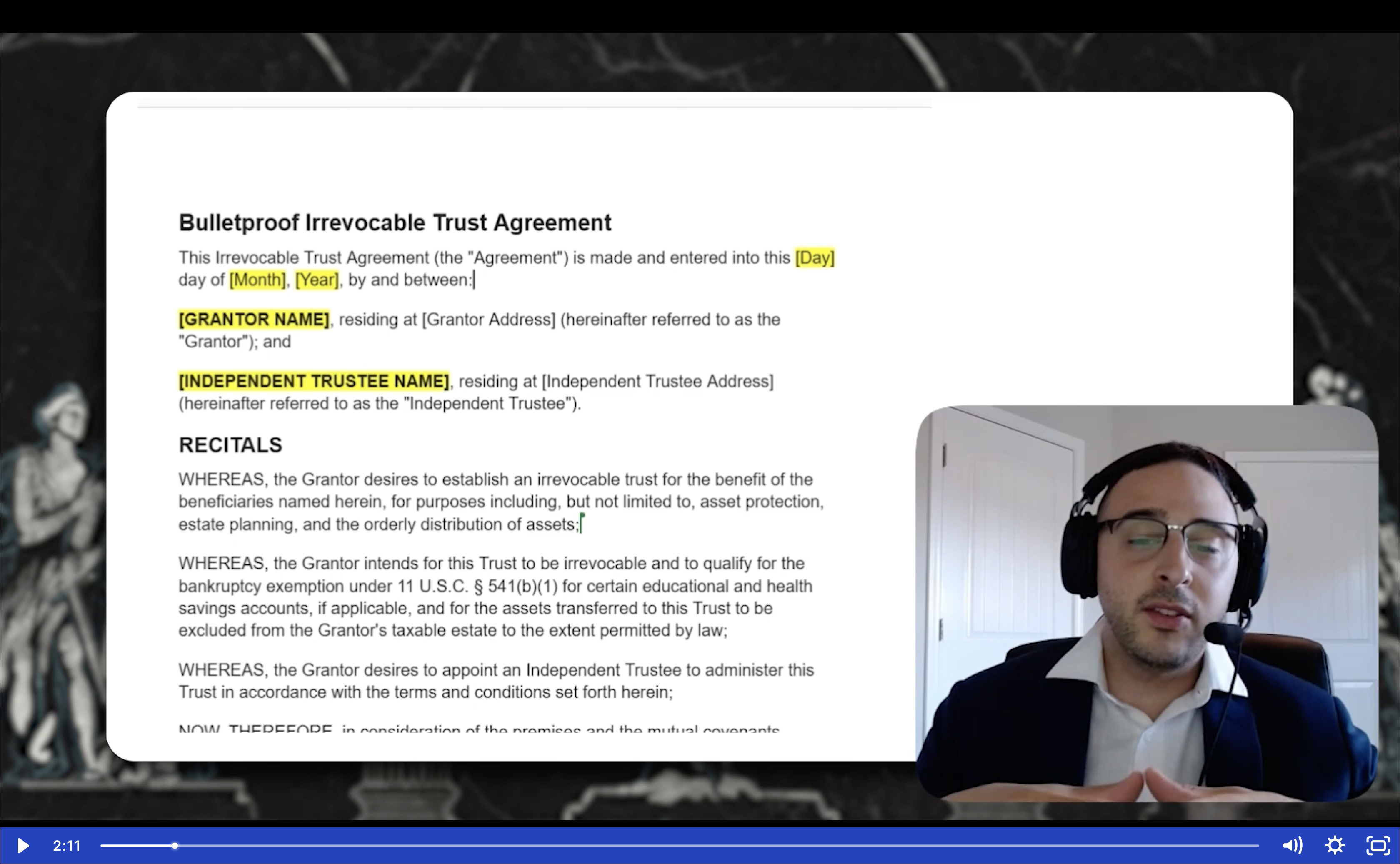
Inside the Bulletproof Trust Secrets video training, our lead trust attorney opens the legal documents and walks you through them page by page. Line by line. You will learn exactly how to structure every clause and fund every asset to shield your legacy from lawsuits, probate, divorce, and the IRS.
You hit play. You pause. You follow along. You build your own fortress.
You will know more about trusts than 95% of general-practice attorneys. You will be in control. Not your lawyer. Not the government. You.
→ Click Here to Access the Video Training ←
Litigation Exposure
Do not let your insurance policy act as a beacon for predators. Take 5 minutes to audit your exposure today:
-
[ ] Search your local county recorder’s office. If your primary residence or rental properties show your personal name on the public deed, you are completely exposed.
-
[ ] Compare your total net worth against your current insurance limits. If your net worth exceeds your policy limits, you are personally self-insuring the dangerous gap.
-
[ ] Check if your corporate entities or LLCs list your home address as the principal place of business. If they do, any asset search will immediately link your business risks to your personal front door.
FROM THE INBOX
Q: "If I transfer my property into a Private Trust, will my current insurance company cancel my policy or raise my premiums?"
A: No. When a property is transferred into a properly structured trust, the insurance policy is simply updated to list the Trust as an "Additional Insured" or "Named Insured." Because the underlying risk of the physical structure hasn't changed, insurance companies process this as a routine administrative update. You maintain your day-to-day coverage while gaining permanent, structural asset protection.
HOW DID YOU LIKE THIS WEEK'S NEWSLETTER?
Your feedback helps us make this briefing even better.
If you found this intelligence valuable, please forward it to a friend or family member who needs to protect their legacy. We grow through your word-of-mouth.
Questions? Reply to this email or contact us at legalteam@lambergg.com
DISCLAIMER: This newsletter is for educational purposes only. Lambergg provides asset protection education, not legal advice. The information presented reflects general principles and may not apply to your specific situation. Tax laws, estate planning rules, and asset protection strategies vary by state and change frequently. Always consult with a qualified attorney and tax professional for advice tailored to your individual circumstances. Nothing in this briefing should be construed as creating an attorney-client relationship.
YOUR TURN
Are you relying purely on insurance to protect your family's life work?
Have you ever verified exactly what a predatory lawyer sees when they search your name in your county's public records?
Reply directly to this email and let me know. I read every single response personally.
Until Friday, protect what matters.
The Lambergg Team