
Welcome back to Lambergg’s Insiders.
As the asset protection industry grows, we are seeing a massive influx of "fake experts" online peddling dangerous, pseudo-legal advice. Over the weekend, we saw a prominent online trust promoter tell their audience: "You should absolutely get a credit card in the name of your Trust to build its credit score!"
If you follow this advice, you will completely obliterate your asset protection in less time than it takes to swipe the card at a gas station.
Today, we are going to look at the terrifying mechanical reality of mixing consumer debt with a protective Trust. We are going to expose exactly why the ultra-wealthy never let their Trusts borrow unsecured money, and how this one simple mistake invites Wall Street banks directly into your family's vault.
Let's dive in.
LEGACY TIP OF THE WEEK
Co-Signer Trap
You want to help your grandson buy his first car, but he has no credit history. The dealership asks you to simply "co-sign" the auto loan so he can get a good interest rate.
When you co-sign a loan, you are not a reference, you are a 100% equally liable debtor. If your grandson misses two payments, the bank will instantly destroy your credit score. Worse, if he gets into a severe car accident and the insurance falls short, the victim's lawyers can sue you personally because your name is legally attached to the vehicle's financing.
Never co-sign a loan. If you want to help a grandchild, gift them the down payment outright from your personal funds. Never tie your decades of pristine credit and your personal liability to a teenager's driving habits.

Why You Never Invite a Creditor Inside
Let’s get one thing straight, the entire purpose of an Irrevocable Asset Protection Trust is to build a wall between your assets and the outside world. It is designed to keep creditors out.
Some online promoters claim that applying for a credit card in your Trust's name is bad because it "transfers your trust from private to public statutory jurisdiction." That is pseudo-legal, sovereign-citizen nonsense.
The real reason you never get a credit card for your Trust is much simpler, and much more devastating: It makes the bank a Direct Creditor.
Here is the mechanical breakdown of why this destroys your wealth:
-
When you apply for a credit card in the name of your Trust, the Trust enters into a direct contractual agreement with a massive financial institution (like Chase or American Express).
-
If a normal plaintiff sues you personally, they have to fight for years in court to try and "pierce" the Trust to get to your money. But when your Trust gets a credit card, the credit card company doesn't have to pierce the vault. You just gave them the keys and invited them inside.
-
If there is ever a dispute, a missed payment, a fraud issue, or a default, the credit card company can sue the Trust directly. Because the Trust is the named debtor, the bank can obtain a judgment to legally seize the assets inside the Trust, including the cash accounts and the family home, to satisfy the debt.

An Asset Protection Trust is a vault, not a consumer. It should hold assets, collect passive revenue, and distribute funds. It should never take on unsecured consumer debt.
If you need a credit card for travel, groceries, or business, you apply for it in your personal name or your operational LLC's name. Let your personal self carry the daily liability. Let your Trust sit quietly in the background, holding your wealth safely out of reach.
CASE STUDY
The Amex Bill That Froze a Family Home
William (62) set up an Asset Protection Trust to hold his $800,000 paid-off home and $200,000 in liquid savings. Wanting to "build credit" for the Trust, William applied for a high-limit American Express card using the Trust's name and Tax ID number.
William's wallet was stolen while traveling in Europe. The thieves charged $45,000 in luxury watches to the Trust's credit card before William realized it and froze the account.

(Anonymized from a recent civil litigation review)
William disputed the charges, but because the transactions occurred overseas with chip-and-pin verification, American Express denied the fraud claim and demanded the $45,000. William refused to pay it on principle.
American Express didn't care. Because the Trust was the primary account holder, Amex sued the Trust directly. They didn't have to prove William was negligent; they only had to prove the Trust breached the cardholder agreement. The judge ruled in favor of the bank and placed an immediate freeze on the Trust's $200,000 savings account.
William was forced to spend $15,000 on attorney fees just to settle the debt and unfreeze his life savings. He learned the hard way: When you give a bank a direct line to your Trust, they will use it.
The Exact Video Training Our Private Clients Use
If you want to ensure that your home, your business, and your cash stay exactly where they belong regardless of what happens with the global economy, you have to take the wheel.
The system wasn't built to protect you. It was built to move your money somewhere else.
We took our complete Bulletproof Trust private client training, the exact step-by-step program we charge up to $20,000 to build for high-net-worth families and recorded the entire thing on video.
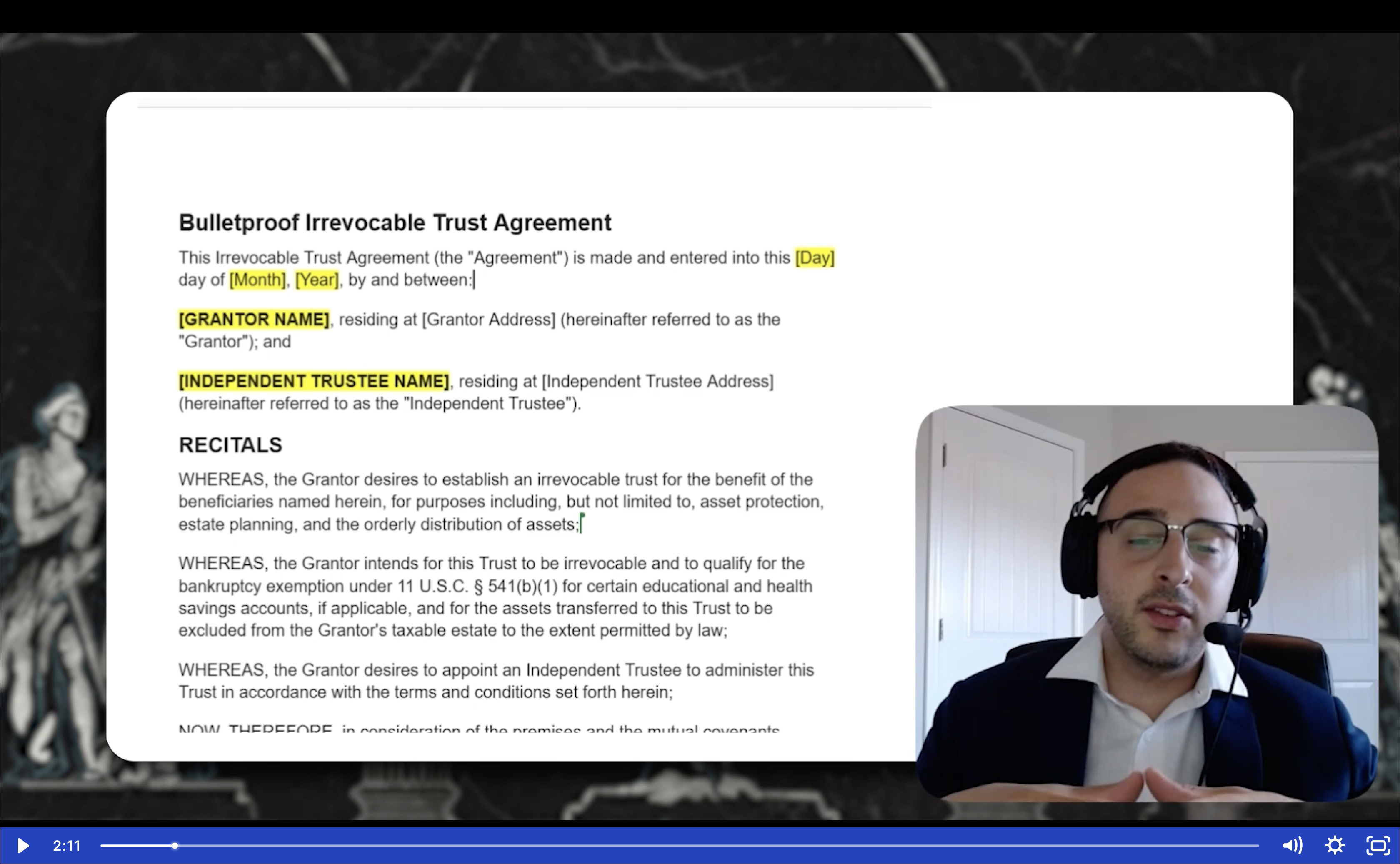
Inside the Bulletproof Trust Secrets video training, our lead trust attorney opens the legal documents and walks you through them page by page. Line by line. You will learn exactly how to structure every clause and fund every asset to shield your legacy from lawsuits, probate, divorce, and the IRS.
You hit play. You pause. You follow along. You build your own fortress.
You will know more about trusts than 95% of general-practice attorneys. You will be in control. Not your lawyer. Not the government. You.
→ Click Here to Access the Video Training ←
Debt Defense
Do not let bad internet advice put your legacy in jeopardy. Take 5 minutes to audit your financial hygiene today:
-
[ ] Pull every credit card in your wallet. If any of them explicitly list the name of your Trust on the front of the card or the monthly statement, call the bank and close the account immediately.
-
[ ] Do not mix your operations with your vault. Your operational LLC should hold the business credit cards. Your Asset Protection Trust should merely hold the ownership shares of the LLC, completely insulated from the LLC's credit debt.
-
[ ] Do not add your children as "Authorized Users" on your high-limit personal credit cards. If they go rogue or lose the card, you are 100% personally responsible for the balance.
FROM THE INBOX
Q: "If I shouldn't get a credit card in the name of the Trust, can I just pay my personal credit card bill directly from the Trust's checking account?"
A: No! This is a massive legal trap known as Commingling.
If a judge sees that your Trust's bank account is directly paying off your personal Visa card for dinners, golf trips, and groceries, the judge will declare the Trust is merely an "alter-ego" or a personal piggy bank. The judge will pierce the veil and destroy the Trust's protection.
The Right Way is the Trust must make a formal, documented "Distribution" (a transfer of cash) to your personal checking account. Once the money lands safely in your personal checking account, you use your personal account to pay your personal credit card bill. Keep the lines clean, and the vault stays locked.
HOW DID YOU LIKE THIS WEEK'S NEWSLETTER?
Your feedback helps us make this briefing even better.
If you found this intelligence valuable, please forward it to a friend or family member who needs to protect their legacy. We grow through your word-of-mouth.
Questions? Reply to this email or contact us at legalteam@lambergg.com
DISCLAIMER: This newsletter is for educational purposes only. Lambergg provides asset protection education, not legal advice. The information presented reflects general principles and may not apply to your specific situation. Tax laws, estate planning rules, and asset protection strategies vary by state and change frequently. Always consult with a qualified attorney and tax professional for advice tailored to your individual circumstances. Nothing in this briefing should be construed as creating an attorney-client relationship.
YOUR TURN
Have you ever been told to build credit in the name of your Trust or LLC?
Are you realizing how easy it is to accidentally invite a creditor directly into your life savings? Reply directly to this email and let me know. I read every single response personally, and it helps me understand exactly what dangerous legal traps we need to expose next.
Until Friday, protect what matters.
The Lambergg Team