Welcome back to Lambergg’s Insiders.
When couples plan for the future, they almost always plan for the same scenario: "What happens if one of us gets sick and needs a nursing home?"
But today, we are going to expose a massive legal blind spot that destroys thousands of family estates every year. We are going to look at the terrifying legal domino effect that happens when the healthy spouse dies first.
Let's dive in.
LEGACY TIP OF THE WEEK
Safe Deposit Box
Generations of Americans were taught to put their most valuable documents like original Wills, Trust documents, and property deeds into a bank safe deposit box.
If you pass away, and your name is the only one on the safe deposit box lease, the bank will instantly freeze the box. Your children cannot simply walk in with a key. They will be forced to hire an attorney and petition the local probate court for a special "Order to Open," which can take weeks or months.
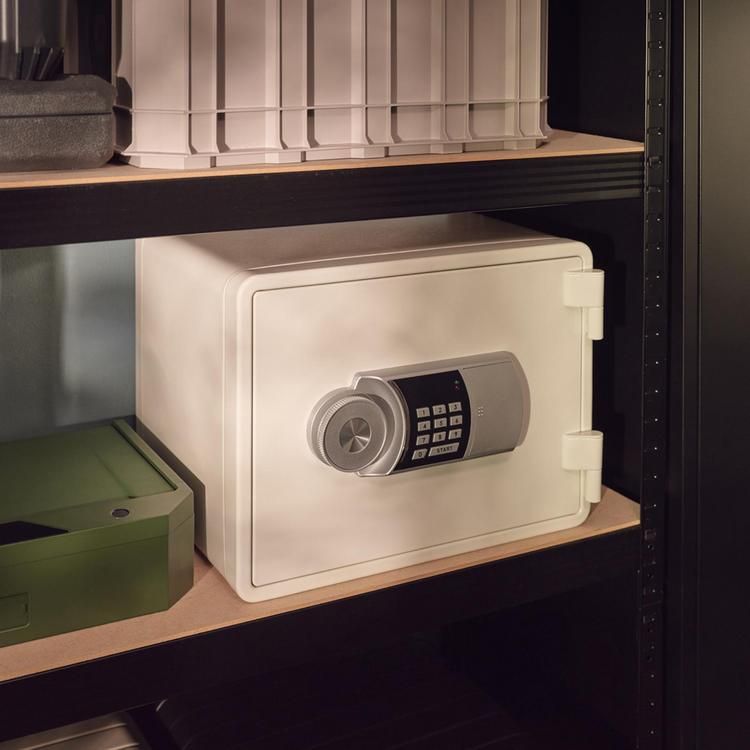
Never store your original estate planning documents in a sole-owner safe deposit box. Keep your original, wet-ink Trust and Will documents in a heavy-duty, fireproof/waterproof safe inside your own home, and ensure your appointed Executor or Successor Trustee knows exactly what the combination is.
Why Dying First Destroys Your Wealth
If you are married and own a home, pull out your property deed. Look at how your names are listed. In 99% of cases, it will say: "John and Mary Smith, Joint Tenants with Right of Survivorship."
When you bought the house, the title agent told you this was the best way to hold the property. If one of you dies, the house automatically transfers to the surviving spouse without going through probate court. It sounds incredibly convenient.
Legally, it is a ticking time bomb for your life savings.
Here is the mechanical breakdown of why "Joint Tenancy" is a devastating illusion for older couples:
-
Let's say your husband develops severe Alzheimer's and requires a memory care facility costing $12,000 a month. You (the "Community Spouse") remain healthy and live at home. When you apply for Medicaid to pay for your husband's care, the government allows you to keep your primary residence. It is classified as an "exempt asset" as long as you live there.
-
Three years later, the stress takes a toll. You, the healthy spouse, suffer a sudden, fatal heart attack in your sleep.
-
Because your deed says Joint Tenants with Right of Survivorship, your half of the house instantly and automatically transfers to your husband.
-
Your husband, who is currently on Medicaid in a nursing home, is now the 100% sole legal owner of a $500,000 house. He no longer lives there, which means the house is no longer exempt. Medicaid will immediately flag him as having "excess assets" and terminate his healthcare coverage.
Your children will be forced to rapidly sell the family home just to pay the $12,000 monthly nursing home bills to keep their father from being evicted. The equity you spent 30 years building evaporates in a matter of months.
You cannot rely on a 1980s property deed to protect modern wealth. The ultra-wealthy sever this liability by transferring the family home into a specialized Irrevocable Asset Protection Trust (like the Bulletproof Trust).
If the healthy spouse dies first, the Trust dictates exactly what happens to the house. Instead of defaulting to the sick spouse, the Trust can lock the equity down, preserve it for the children, and keep it completely off the sick spouse's balance sheet, ensuring Medicaid continues to pay the nursing home bills without interruption.
CASE STUDY
The Widow's Heart Attack That Cost $450,000
Arthur (78) and Helen (76) had been married for 50 years. They owned a beautiful home worth $450,000, free and clear, held as Joint Tenants. Arthur suffered a series of strokes and required 24/7 skilled nursing care. Helen worked with the state to qualify Arthur for Medicaid, and she continued living peacefully in their home.
Two years later, Helen was involved in a fatal car accident. She had a standard "I Love You" Will that left everything to Arthur.
(Anonymized from a recent elder law review in Texas)
Between the Right of Survivorship on their deed and the language in her Will, 100% of Helen's assets, the $450,000 house and $80,000 in savings transferred directly into Arthur's name. The state Medicaid office ran a routine automated asset check on Arthur three months later. They saw a half-million dollars suddenly appear on his ledger. Medicaid immediately disqualified him and demanded retroactive repayment for the months he received care while owning the assets. Arthur's children had to fire-sale the family home and hand the proceeds directly to the nursing facility. The children inherited absolutely nothing, all because Helen assumed a standard property deed and a basic Will were enough to protect them.
How to Build a Court-Tested, Lawsuit-Proof Trust
Here is the truth the legal industry desperately wants to hide from you:
Having a basic trust document without understanding how to actually build it, fund it, and operate it is like having a bank vault with no walls. The papers look impressive, but when a crisis hits, the binder doesn't save you.
What saves you is knowing exactly how to structure every clause, fund every asset, and operate every part of the Trust the way our top-tier attorneys do it for their private clients.
We took our complete Bulletproof Trust private client training, the exact step-by-step program high-net-worth families use to shield their wealth from lawsuits, probate, and the IRS and recorded the entire thing on videos.
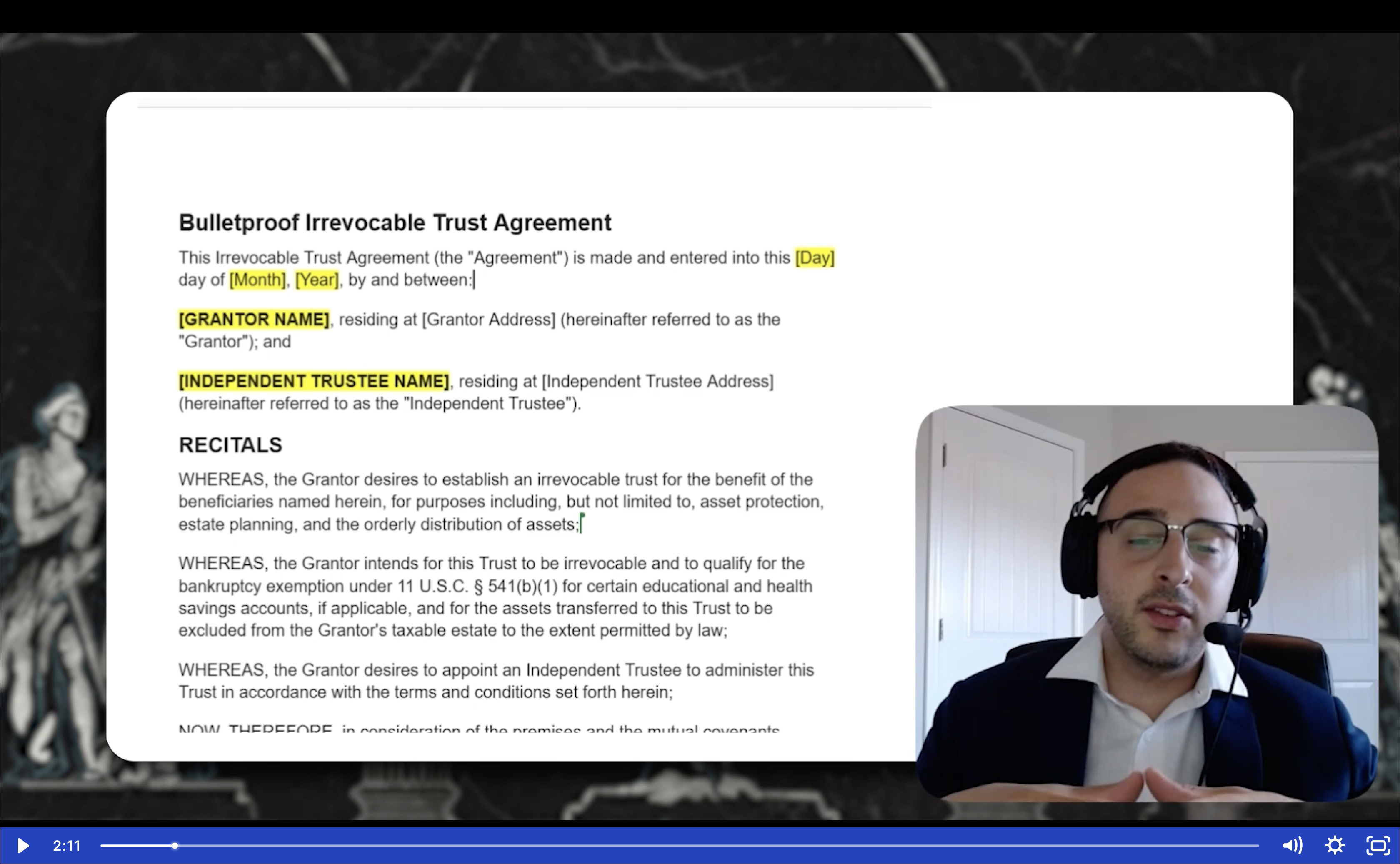
Our lead trust attorney sits down, opens the documents, and walks you through them page by page. You hit play. You pause. You follow along. You build your own fortress.
You will know more about trusts than 95% of general-practice attorneys. You will be in control. Not your lawyer. Not the government. You.
→ Click Here to Access the Video Training ←
Deed Defense Audit
Do not leave your family’s most valuable asset exposed to an automated government database. Take 10 minutes to audit your exposure today:
-
[ ] Locate Your Deed: Do not assume you know how your house is titled. Pull your original deed or look it up on your county property appraiser's website.
-
[ ] Look for the Danger Words: If you see "JTWROS," "Joint Tenants," or "Tenants by the Entirety," your home is currently programmed to automatically transfer to the surviving spouse, regardless of their health or Medicaid status.
-
[ ] Review the "Contingency" Plan: Ask yourself: If I pass away tomorrow, will my spouse inherit my assets in a way that disqualifies them from government healthcare? If the answer is yes, you need to restructure your estate immediately.
FROM THE INBOX
Q: "If my husband is sick and I am healthy, can't I just take his name off the deed and put the house solely in my name to protect it?"
A: Medicaid treats transfers between spouses differently than transfers to children, so moving the house to the "Community Spouse" is often part of the initial Medicaid planning process.
However, putting the house solely in your name does not solve the "Healthy Spouse Trap." If the house is in your name alone, and you die unexpectedly, what does your Will say? If your Will leaves your estate to your husband, the house goes right back to him in probate court, disqualifying him from Medicaid all over again.
To permanently break the chain of liability, the house must be routed into an Asset Protection Trust that explicitly protects the assets for the next generation while allowing the sick spouse to continue receiving Medicaid benefits.
HOW DID YOU LIKE THIS WEEK'S NEWSLETTER?
Your feedback helps us make this briefing even better.
If you found this intelligence valuable, please forward it to a friend or family member who needs to protect their legacy. We grow through your word-of-mouth.
Questions? Reply to this email or contact us at legalteam@lambergg.com
DISCLAIMER: This newsletter is for educational purposes only. Lambergg provides asset protection education, not legal advice. The information presented reflects general principles and may not apply to your specific situation. Tax laws, estate planning rules, and asset protection strategies vary by state and change frequently. Always consult with a qualified attorney and tax professional for advice tailored to your individual circumstances. Nothing in this briefing should be construed as creating an attorney-client relationship.
YOUR TURN
Does your current Will or property deed automatically leave everything to your spouse?
Have you ever considered what would happen to your assets if you, the healthy spouse, passed away first? Reply directly to this email and let me know. I read every single response personally, and it helps me understand exactly what life-saving strategies we need to tackle next.
Until Tuesday, protect what matters.
The Lambergg Team